Is Your Website an Asset or a Liability?
Your website is at risk.
I’m not saying this to try and scare you, but that’s the reality of the world we live in. More than 50,000 websites get hacked each day.
You can’t have the “it won’t happen to me” mentality. I encounter businesses all the time who feel this way. They think hackers have bigger fish to fry and don’t have any reason to target their website. That’s simply not the case. In fact, 43% of cyber crimes are against small businesses.
Roughly 54% of companies worldwide say they have experienced at least one attack within the last year. Just 38% of businesses say they’re prepared to handle cyber attacks.
I don’t have a magic crystal ball or some way to see into the future, but my gut tells me that cyber criminals aren’t going to just wake up one day and decide to stop hacking websites. So you need to take steps to improve your website security.
I’ll help you with what needs to be done to secure your website today, in 2019.

Is Your Website Secure For Your Customers?
Google Chrome Requires an SSL Certificate since July 1, 2018
With so much in the news about internet security, hacking and malware, tech issues can seem overwhelming to the average business owner. But there is something fairly simple you can do right now to make your website safer for your customers. You can buy an SSL certificate. Here’s why:
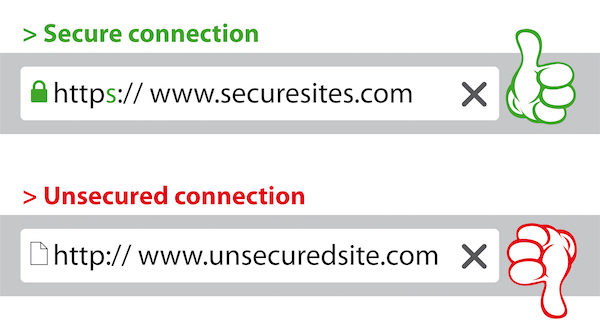
Starting from July 2018, Google has identified any site that does not provide an encrypted connection as ‘Not Secure’. Anyone visiting your website using a Google Chrome browser will see these words will prominently be displayed to the left of any non-SSL website domain. Basically, if your site address reads HTTP:// instead of HTTPS:// from July 1st 2018, you will have received less Chrome traffic, because consumers will shy away from visiting your site. And since 60 percent of Internet users today use Google Chrome almost exclusively, this is the obvious reason to run out and buy yourself an SSL Certificate.
Do I Need an SSL Certificate to Be GDPR Compliant?
The short answer is yes, most websites need an SSL certificate to be GDPR compliant, but it depends on what information your website collects.
Does Your Site Collect Any Information from Your Users?
If your site collects and stores any information from your users then it is a safe bet to have an SSL certificate on your site to protect the user information.
This is because, although the GDPR does not specifically say that every site needs an SSL certificate in order to be GDPR compliant, if your site collects or processes user data then under the GDPR, you have a responsibility as a data controller or a data processor, to keep this information secure and protected, which by having an SSL on your site you are helping to achieve this.
This information could be collected from users via sign-up or contact forms, and could be as simple as a name, email address, or a phone number.
However, this user information still needs to be secured. By not having an SSL you are only increasing the risk of a data breach. If your site is an eCommerce site which takes user payment information such as bank details then having an SSL is a necessity.
Need help installing an SSL certificate?
Install SSL Certificate PLUS:
Install SSL Certificate PLUS: